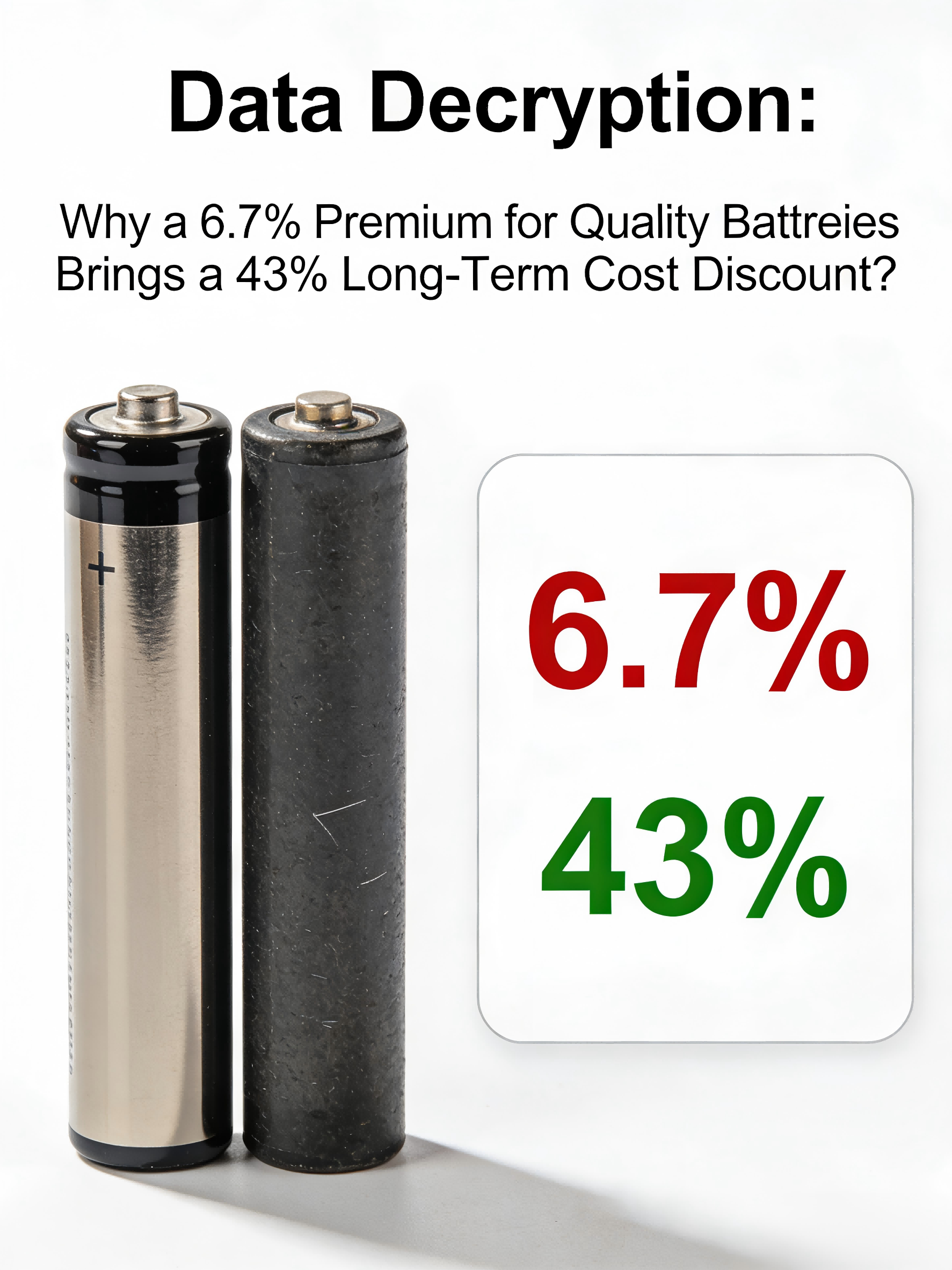
Data-Driven Insights: Why the "Premium" for High-Quality Lithium Batteries Is Actually a "Discount"

In the world of lithium battery procurement, the term "premium" often gives buyers pause. When a high-quality lithium battery is quoted 5%, 10%, or even 15% higher than a standard product, procurement decision-makers instinctively view it as an "additional cost" requiring careful consideration.
However, we will use undeniable data to reveal a counterintuitive truth: this initial investment, which appears to be a "premium," is essentially an upfront "discount" that delivers substantial future returns. Let's re-examine this issue with a calculator, not just intuition.
Redefining "Price": From "Unit Cost" to "Cost Per Use"
The traditional view of price focuses on the cost at the point of purchase – the unit price ($/Wh). However, a lithium battery is a capital expenditure whose value is realized over its entire lifecycle. Therefore, a more scientific evaluation metric is the "Cost Per Cycle":
Cost Per Cycle = Battery Unit Price ÷ Cycle Life (number of cycles)
This formula is key to understanding how a "premium" transforms into a "discount."
Data Comparison: The Long-Term Game of "Cheap" vs. "Quality"
Let's use core data for a clear comparison:
|
Parameter |
Cheap Battery A |
High-Quality Battery B |
Difference Analysis |
|---|---|---|---|
|
Unit Price |
$0.15/Wh |
$0.16/Wh |
Battery B has a 6.7% "premium" |
|
Cycle Life |
800 cycles |
1500 cycles |
Battery B lifespan is 87.5% longer |
|
Cost Per Cycle |
$0.0001875/Wh/cycle |
$0.0001067/Wh/cycle |
Battery B's actual usage cost is 43% lower |
Mathematical Proof: How the "Discount" is Achieved
-
The one-time purchase cost per Wh of energy is higher for Battery B than Battery A by:
($0.16 - $0.15) = $0.01 -
But Battery B converts this $0.01 "premium" into an extended cycle life of 700 cycles (1500 - 800).
-
The additional cost per cycle contributed by this 0.01is:‘0.01 / 700 cycles = $0.0000143/Wh/cycle`.
Key Finding: The extra 0.01youpayforthehigh−qualitybatteryessentially"purchases"cycleserviceforaslowas0.0000143/Wh. In contrast, the cost per cycle for Cheap Battery A is a hefty $0.0001875/Wh. This means the high-quality battery delivers the same watt-hour of energy at less than 1/13th the unit cost of the cheap battery.
The initial 6.7% "premium" translates into a staggering 43% reduction in long-term usage costs. Isn't that an extremely cost-effective "discount" deal?
Beyond the Formula: The Triple Value Behind the Quality "Premium"
The "premium" you pay is not arbitrary; it's an investment in core value drivers that collectively create the low "Cost Per Cycle":
-
Value of R&D: The premium partly covers advanced materials science and intelligent electrolyte formulations, which are the foundation of long life.
-
Value of Manufacturing Precision: Investments in fully automated stacking processes, strict moisture control, and 100% cell grading ensure exceptional consistency and reliability, reducing early failure risk.
-
Value of Risk Mitigation: The higher initial investment essentially buys "reliability insurance" and "safety insurance," significantly reducing potential losses from batch failures, after-sales repairs, safety incidents, and brand reputation damage.
Conclusion: Make an Informed Procurement Investment
Choosing a lithium battery is less of a simple purchase and more of an investment. You are investing in the battery's entire lifecycle, not just its condition ex-factory.
The real "discount" lies not in the price concession obtained at purchase, but in the maximum optimization of the Total Cost of Ownership (TCO) over the entire usage period. The next time you receive a quote for a high-quality battery, be sure to ask the supplier this critical question: "Based on cycle life data, what is this battery's Cost Per Cycle?"
When you start thinking in terms of "Cost Per Use," you will find that the most competitive price often lies hidden within those high-quality products that initially appear to carry a slight "premium."
Next Step:
Our Cost Per Cycle Calculator can help you quickly and accurately simulate the long-term costs of different battery options for your specific application scenario. Contact our technical team to receive a personalized cost-benefit analysis report based on your project parameters, and let data guide you to the most valuable investment decision.
About Soltrust: We are committed to providing lithium battery solutions based on long-life design. We firmly believe that true customer value lies in the lowest Total Cost of Ownership (TCO). Our products, leveraging cutting-edge material technology and precision manufacturing, ensure a cycle life exceeding industry standards by over 30%, helping you transform today's "premium" investment into visible long-term returns.
The Future is Now: Lifecycle Cost-Based Procurement Becomes the New Standard in Lithium Battery Sourcing
From Materials to Process: How High-Quality Lithium-Iter Batteries Achieve 1,500-Cycle Lifespan
Related Article