
Data Decoded: Why a 6.7% "Premium" for Quality Batteries Delivers a 43% Long-Term Cost "Discount"
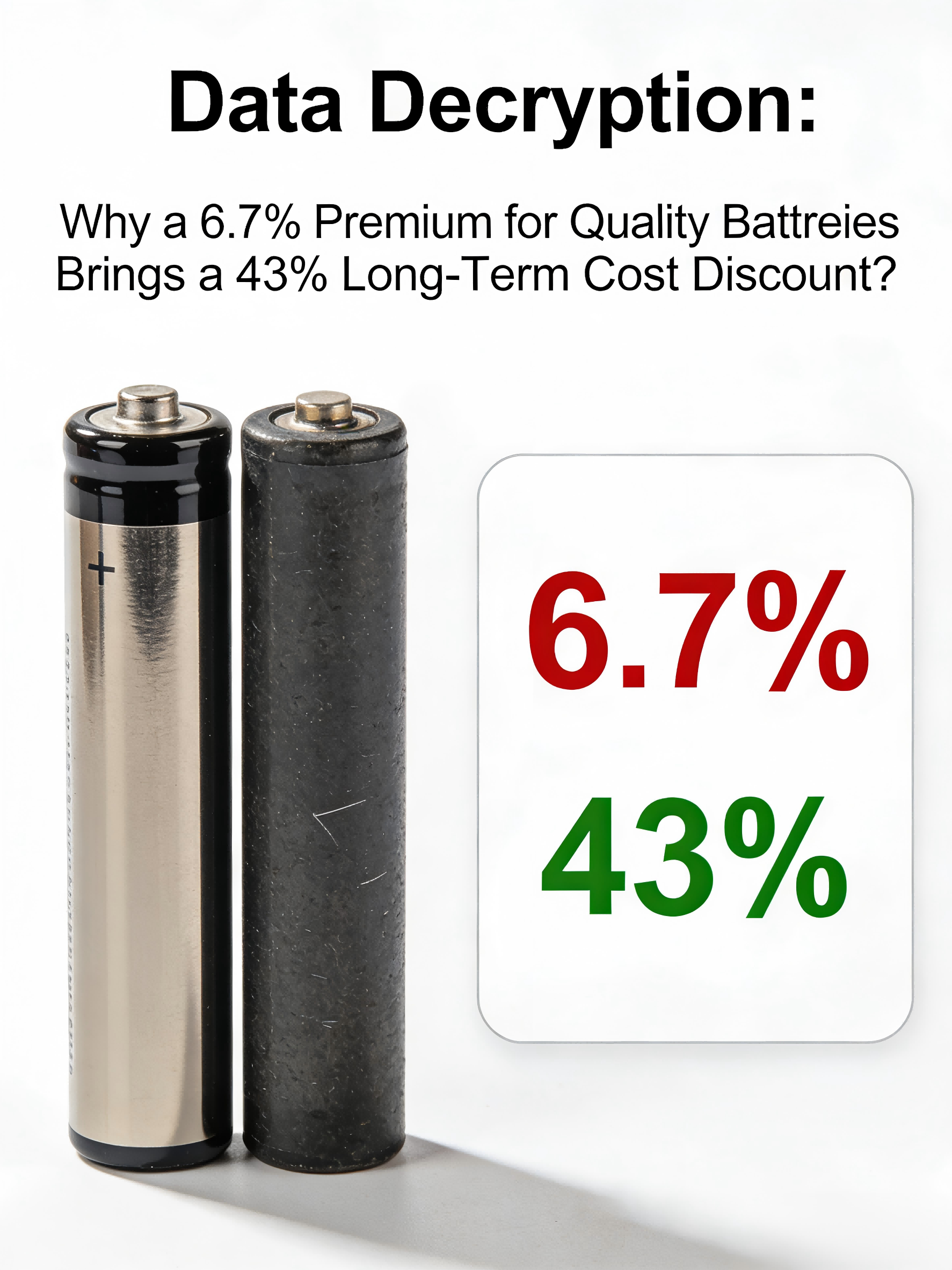
Data Decoded: Why a 6.7% "Premium" for Quality Batteries Delivers a 43% Long-Term Cost "Discount"
"A 6.7% price increase? This deal won't fly."
This is the most common gut reaction from procurement professionals when faced with a quote for high-quality lithium batteries. However, the true ledger of costs is often hidden behind the "unit price," revealed by a smarter metric: Cost Per Cycle. Today, we use data to decode why this seemingly higher upfront payment is, in fact, a highly rewarding "discount."
1. The "Visual Trap" of Traditional Procurement: Seeing Only the Tip of the Iceberg
In lithium battery procurement, most fall into the same "visual trap": focusing solely on the most visible figure—the "price per watt-hour." It's like navigating an iceberg while only seeing the 10% above water, ignoring the 90% below that determines the ship's fate.
The trap's logic is simple:
-
Battery A: Unit Price $0.15/Wh
-
Battery B: Unit Price $0.16/Wh
-
Conclusion: Battery A is "cheaper" and offers better value.
This conclusion ignores a critical fact: The value of a lithium battery is released gradually over its entire lifecycle, through thousands of charge-discharge cycles. Its price should not be judged by the cost at the "point of purchase," but by the cost "per use."
2. Introducing "Cost Per Cycle": Illuminating the Hidden Cost Iceberg
To see the full picture, we need a more scientific evaluation metric—Cost Per Cycle.
Formula: Cost Per Cycle = Battery Unit Price ÷ Cycle Life (number of cycles)
This formula directly links the "one-time procurement cost" with "long-term usage value." Let's calculate with real data:
|
Evaluation Dimension |
Cheap Battery A |
Quality Battery B |
Direct Comparison |
|---|---|---|---|
|
Unit Price ($/Wh) |
0.15 |
0.16 |
Battery B is "6.7% more expensive" |
|
Cycle Life (cycles) |
800 |
1500 |
Battery B "lasts 87.5% longer" |
|
Cost Per Cycle ($/Wh/cycle) |
0.0001875 |
0.0001067 |
Battery B is "43% cheaper per use" |
Data Decoded:
Surface Premium: Per watt-hour of energy, purchasing Battery B costs $0.16 - $0.15 = $0.01more than Battery A.
Value Transformation: This $0.01 premium "buys" you an additional 1500 - 800 = 700cycles of life.
True Cost: The cost per cycle contributed by this 0.01is:‘0.01 ÷ 700 cycles ≈ $0.0000143/Wh/cycle`.
Core Finding: Quality Battery B delivers an additional watt-hour cycle at an extremely low marginal cost of just 0.0000143∗∗percycle.Incontrast,CheapBatteryA′scostpercycleisahefty∗∗0.0001875. Battery B's unit usage cost is less than 1/13th of Battery A's.
The initial 6.7% premium is drastically amortized over a longer service life, ultimately achieving a staggering 43% reduction in long-term operational costs. This is the mathematical magic of how a "premium" becomes a "discount."
3. The Triple Value Investment Behind the Premium
The "premium" you pay is not for the brand name; it's a direct investment in three core values that collectively build the low "Cost Per Cycle":
-
Investment in "Time" – R&D
-
Materials Science: The premium funds advanced materials like single-crystal cathodes and silicon-carbon anodes, slowing capacity fade at its root.
-
Electrochemical System: It enables the development of proprietary electrolyte additives that form more stable electrode interface films (SEI/CEI), the chemical foundation of long life.
-
-
Investment in "Stability" – Manufacturing Precision
-
Consistency Assurance: The premium covers costs for fully automated stacking processes, -45°C dew point dry rooms, and 100% cell grading. Exceptional product consistency avoids the "weakest link" effect, ensuring the entire battery pack reaches its designed lifespan.
-
Reliability Foundation: Precision manufacturing reduces defects and early failure risks from the source, minimizing maintenance costs.
-
-
Investment in "Peace of Mind" – Risk Mitigation
-
This is the highest-value investment: A higher initial outlay is equivalent to purchasing "reliability insurance" and "safety insurance" for your project. It significantly reduces the potential for post-sales crises due to batch failures, massive compensation from safety incidents, and the intangible loss of brand reputation. This "peace of mind" cannot be measured by short-term price differences.
-
4. Conclusion: Shift from a "Cost Mindset" to an "Investment Mindset"
Selecting a lithium battery should be viewed as an asset investment, not a one-time consumable purchase. What you are investing in is the total energy and value the battery can deliver over its entire service cycle.
True cost optimization lies not in shaving a few percentage points off the unit price at the negotiating table, but in achieving the lowest Total Cost of Ownership (TCO) over the product's entire lifecycle.
The next time you evaluate a battery solution, we advise posing this game-changing question to your supplier:
"Setting aside unit price, based on test reports, what is this battery's 'Cost Per Cycle'?"
When you begin to think and decide in terms of "Cost Per Cycle," you will find that the most competitive price often belongs to those high-quality products that initially require some "foresight" to choose.
Drive Your Next Decision with Data:
Our technical team can provide you with a free, customized TCO analysis report. Simply provide your application scenario and key parameters, and we will use a detailed data model to clearly show you the true cost comparison of different battery solutions over 3, 5, or even 10 years.
About Soltrust: We firmly believe that true customer value lies in the lowest Total Cost of Ownership. We specialize in long-life design, transforming your "premium" investment today into a sustained "cost discount" realized over the coming years. Our products offer a cycle life exceeding industry standards by over 30%, helping global clients make smarter long-term investments.
From Cell to System: How Battery Pack Integration Design Maximizes Performance and Safety
The Future is Now: Lifecycle Cost-Based Procurement Becomes the New Standard in Lithium Battery Sourcing
Related Article