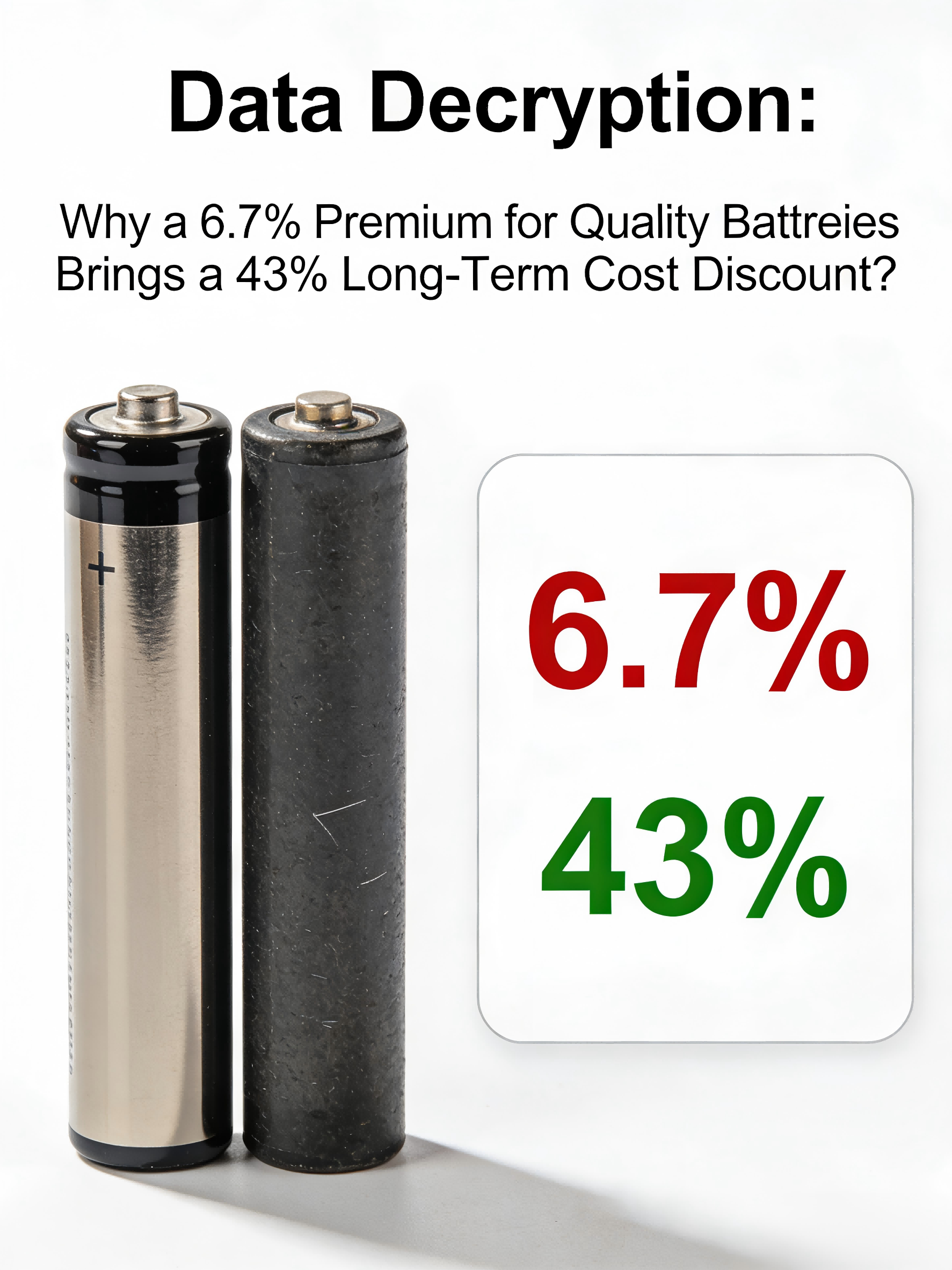
Data Revealed: How High-Quality Lithium Batteries Achieve 43% Cost Savings Through Longer Lifespan
"Is a lower unit price always better value?" This may be the most dangerous misconception in lithium battery procurement. This article demonstrates, with real data, how choosing high-quality lithium batteries can achieve up to 43% in long-term cost savings through a significantly longer cycle life.
Cycle Life: The Overlooked Cost Determinant
In lithium battery procurement decisions, many buyers focus excessively on the initial unit price while neglecting the most critical cost metric: cost per cycle. This simple formula reveals the true cost-effectiveness:
Cost Per Cycle = Battery Unit Price ÷ Cycle Life (number of cycles)
Let's compare two batteries of different qualities using specific data:
Data Comparison: Cost Analysis of Cheap Battery vs. High-Quality Battery
|
Parameter |
Cheap Battery A |
High-Quality Battery B |
Difference Analysis |
|---|---|---|---|
|
Unit Price |
$0.15/Wh |
$0.16/Wh |
Battery B is 6.7% more expensive |
|
Cycle Life |
800 cycles |
1500 cycles |
Battery B lasts 87.5% longer |
|
Cost Per Cycle |
$0.0001875/Wh/cycle |
$0.0001067/Wh/cycle |
Battery B costs 43% less per cycle |
Mathematical Proof of Cost Savings
Based on the data above:
-
Cost per cycle for Battery A: 0.15÷800=∗∗0.0001875/Wh/cycle**
-
Cost per cycle for Battery B: 0.16÷1500=∗∗0.0001067/Wh/cycle**
Cost Saving Rate = [(0.0001875−0.0001067) ÷ $0.0001875] × 100% = 43%
This means that although the high-quality battery has a 6.7% higher initial unit price, its long-term operational cost is actually 43% lower.
Key Technical Factors Affecting Cycle Life
High-quality lithium batteries achieve longer service life through the following technological innovations:
-
Advanced Electrode Material Technology
-
Uses silicon-carbon composite anode materials to alleviate volume expansion.
-
Employs single-crystal cathode materials to reduce particle cracking.
-
Optimized electrode coating process ensures structural stability.
-
-
Intelligent Electrolyte Formulation
-
Proprietary additive packages form a stable SEI film.
-
Enhanced high-temperature tolerance reduces side reactions.
-
Optimized low-temperature performance extends the operating range.
-
-
Precision Manufacturing Processes
-
Fully automated stacking process ensures precise electrode alignment.
-
Strict moisture control reduces impurity content.
-
100% cell grading guarantees batch consistency.
-
Cost Impact in Real-World Applications
Scenario 1: Home Energy Storage System (10 kWh Capacity)
-
Cheap Battery A: Requires replacement after 3 years. Total cost = 1500×2=∗∗3000**
-
High-Quality Battery B: Service life of 6 years. Total cost = $1600
-
Total savings over 6 years: 3000−1600 = $1400 (Savings of 47%)
Scenario 2: Power Tool Battery Pack (2.0Ah)
-
Based on calculation of one charge/discharge cycle per day.
-
High-quality batteries can save $85 in replacement costs annually compared to cheap batteries.
-
Over a two-year period, a single battery can save $170.
Professional Recommendations for Procurement Decisions
-
Request Cycle Life Test Reports
-
Confirm the testing standard (e.g., IEC 62620).
-
Verify if test conditions match the actual usage scenario.
-
Request reports from third-party testing agencies.
-
-
Establish a Total Cost of Ownership (TCO) Analysis Model
-
TCO = Procurement Cost + Operational Cost + Replacement Cost + Disposal Cost
-
-
Develop a Scientific Battery Evaluation Criteria
-
Recommended weight for Cycle Life: 40%
-
Recommended weight for Efficiency Performance: 30%
-
Recommended weight for Safety & Reliability: 30%
-
Conclusion: Redefining "Cost-Effectiveness"
In lithium battery procurement, true "cost-effectiveness" refers not to the lowest initial price, but to the lowest Total Cost of Ownership (TCO). Data shows that while choosing high-quality lithium batteries requires a higher initial investment, it leads to significant cost savings through a longer service life.
Smart procurement decisions should be based on data, not just intuition. When evaluating battery suppliers next time, be sure to request detailed cycle life data and cost-per-cycle calculations.
Pro Tip: Use our provided "Cost-Per-Cycle Calculator" for your next battery procurement project to make data-driven decisions. Contact our technical team for a personalized cost-benefit analysis report.
About Soltrust: We specialize in providing high-cycle-life lithium battery solutions. Through advanced material technology and precision manufacturing processes, we help customers achieve the lowest Total Cost of Ownership. Our battery products have been tested by authoritative institutions, with a cycle life exceeding industry standards by over 30%.
From 3 Years to 6 Years: How High-Quality Batteries Are Redefining Equipment Replacement Cycles
Stop Just Comparing Unit Prices! The 3 Often Overlooked Costs in Lithium Battery Procurement
Related Article