Cost Reduction Without Quality Loss: 3 Hidden Costs Beyond Unit Price When Procuring Lithium Batteries

As a professional lithium battery supplier engaged in global trade, we interact daily with international purchasers. A common trend we observe is that many procurement decisions remain overly focused on the visible figure of "price per watt-hour." While controlling initial costs is undoubtedly important, solely chasing the lowest unit price often leads businesses into a "false economy" trap, ultimately resulting in a higher Total Cost of Ownership (TCO).
This article breaks down the three major hidden costs that deserve more attention than just the unit price when procuring lithium batteries. Understanding these is key to achieving genuine cost reduction without compromising quality.
Hidden Cost #1: Cycle Life Cost – Calculating the True "Cost Per Cycle"
The Pitfall: Comparing two batteries: Product A at 0.15/WhandProductBat0.16/Wh. Intuitively, A seems cheaper.
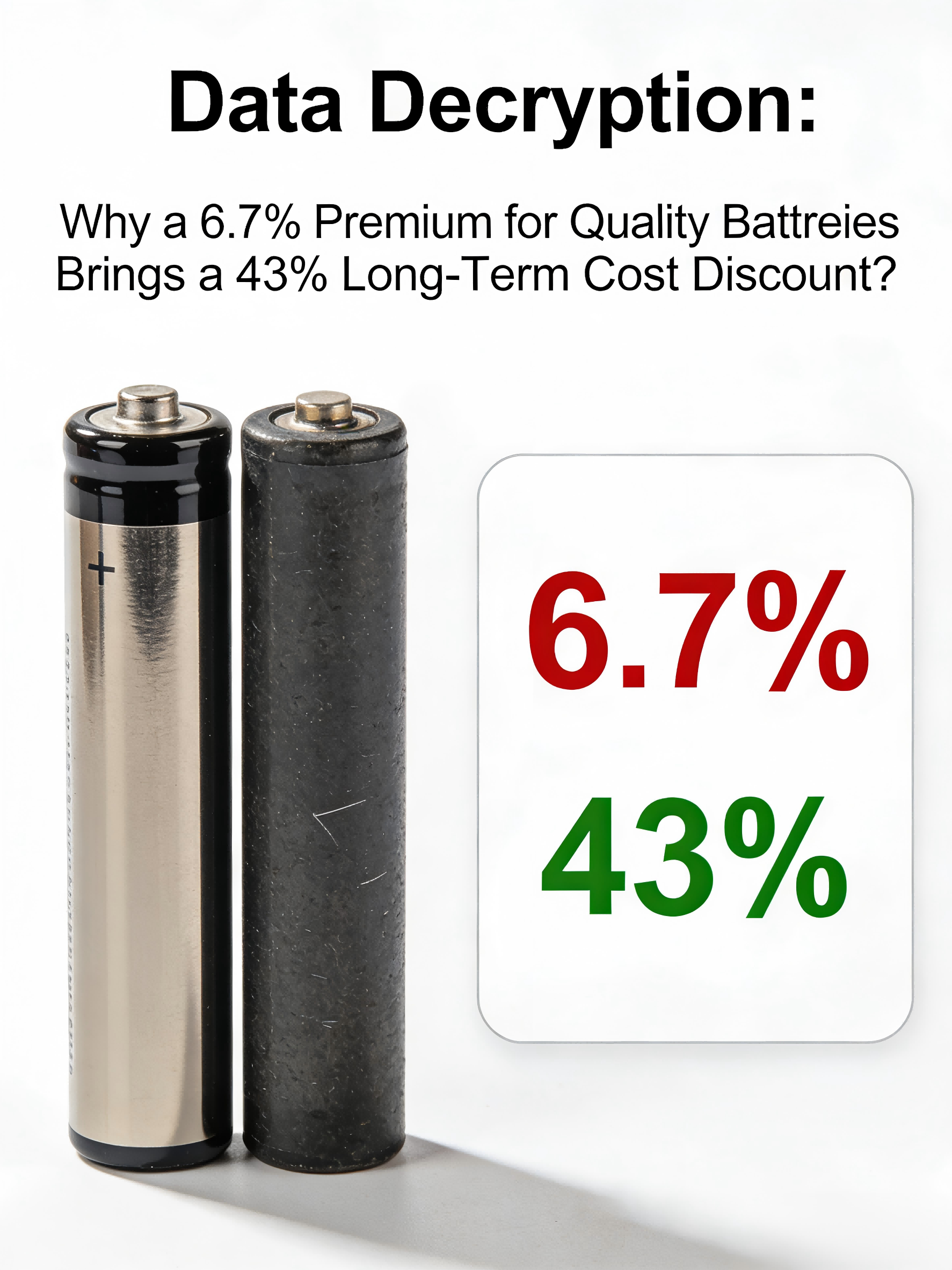
The Reality: If Product A has a rated cycle life of 800 cycles (to 80% capacity retention), while Product B, thanks to superior electrolyte formulation and process control, achieves 1500 cycles, the real "cost per cycle" tells a different story:
-
Cost per cycle for A = 0.15/800≈∗∗0.0001875/Wh/cycle**
-
Cost per cycle for B = 0.16/1500≈∗∗0.0001067/Wh/cycle**
The Result: The long-term usage cost of Product B is actually about 43% lower than Product A. For applications involving frequent charge/discharge cycles like energy storage systems, power tools, and e-bikes, cycle life is the core determinant of total cost.
Actionable Advice for Buyers:
-
Always request the cell's cycle test data (referencing standards like IEC 62620) and check if the test conditions mirror your real-world application.
-
Understand key lifespan-influencing technologies (e.g., anode materials like silicon blending, electrolyte additives, charge/discharge rates - C-rate) and ask suppliers to elaborate during inquiries.
Hidden Cost #2: Efficiency & Energy Loss Cost – The Price of "Wasted" Energy and Heat
The Pitfall: Focusing only on battery capacity (Ah), while ignoring energy losses during charge and discharge.
The Reality: A battery's internal resistance (IR) directly impacts its efficiency. High-IR batteries generate more heat during operation, leading to:
-
Reduced Usable Energy: If you buy a 1000Wh battery with 95% efficiency, only about 950Wh is effectively available.
-
Increased Thermal Management Costs: Requiring more complex cooling systems, adding to BMS and structural component costs.
-
Higher Charging Costs: Lower efficiency means longer charging times and increased electricity bills.
Actionable Advice for Buyers:
-
Pay attention to the battery's nominal internal resistance and energy efficiency (charge/discharge efficiency).
-
Inquire about efficiency performance under different temperatures and load currents. High-quality cells exhibit a more gradual efficiency decline under high temperatures or high currents.
-
For large-scale energy storage projects, even a 0.5% efficiency gain can translate to significant long-term electricity savings.
Hidden Cost #3: Maintenance & Failure Cost – Insuring Against Reliability and Safety Risks
The Pitfall: Opting for a lower-priced battery shows immediate savings on the initial purchase cost.
The Reality: Lack of reliability triggers a chain reaction of costly subsequent expenses:
-
After-sales & Maintenance Costs: High failure rates mean frequent repairs, replacements, involving labor, logistics, and spare parts inventory.
-
System Downtime Losses: For commercial operations (e.g., battery swapping stations, telecom base stations) or industrial equipment, battery failure causing downtime can lead to significant revenue loss.
-
Safety Risk Costs: This is the most potentially devastating cost. Using cells of unstable quality or poor consistency can pose thermal runaway risks, threatening property safety and brand reputation.
Actionable Advice for Buyers:
-
Scrutinize the supplier's quality system: Do they hold certifications like IATF 16949? How do their manufacturing processes (capacity grading, aging tests) ensure consistency?
-
Focus on BMS co-design: A superior BMS is not an add-on but the "brain" of the battery system. Does it provide precise cell balancing, accurate state estimation (SOC/SOH), and fault预警 (early warning)?
-
Request safety certifications and test reports: Such as UL, CE, UN38.3, and understand the safety designs (e.g., venting mechanisms, thermally stable separators).
Summary: The Smart Procurement Checklist
Next time you evaluate lithium battery suppliers and quotes, move beyond just the unit price. Use this checklist to engage in a professional dialogue with your potential partners:
-
Quantify Long-Term Value: "Please provide a comparative analysis based on cost per cycle, supported by cycle test reports."
-
Assess Full-Range Efficiency: "Can you specify the cell's energy efficiency data under 1C charge/discharge rates at 25°C and 45°C?"
-
Audit Reliability Credentials: "May we understand your cell sorting and grouping standards and the core protection logic of your BMS? Please share key safety certifications."
-
Validate Application Cases: "Are there long-term cooperation case studies available for reference from clients in similar application scenarios as ours?"
At Soltrust, we firmly believe that true value lies not in offering the lowest quote, but in enabling the lowest Total Cost of Ownership (TCO) for our clients. We are committed to working with you, delving into technical details from cell chemistry and structural design to system integration, to deliver the optimal solution based on lifecycle cost analysis.
What specific battery application are you currently procuring for, and which cost aspect is your primary focus? Feel free to leave a comment or contact us directly for a personalized technical analysis tailored to your needs.
Stop Just Comparing Unit Prices! The 3 Often Overlooked Costs in Lithium Battery Procurement
How to Optimize Charging When You Only Have a Home AC Charger
Related Article