Battery Recycling: An Eco-Business or Policy-Driven Industry?
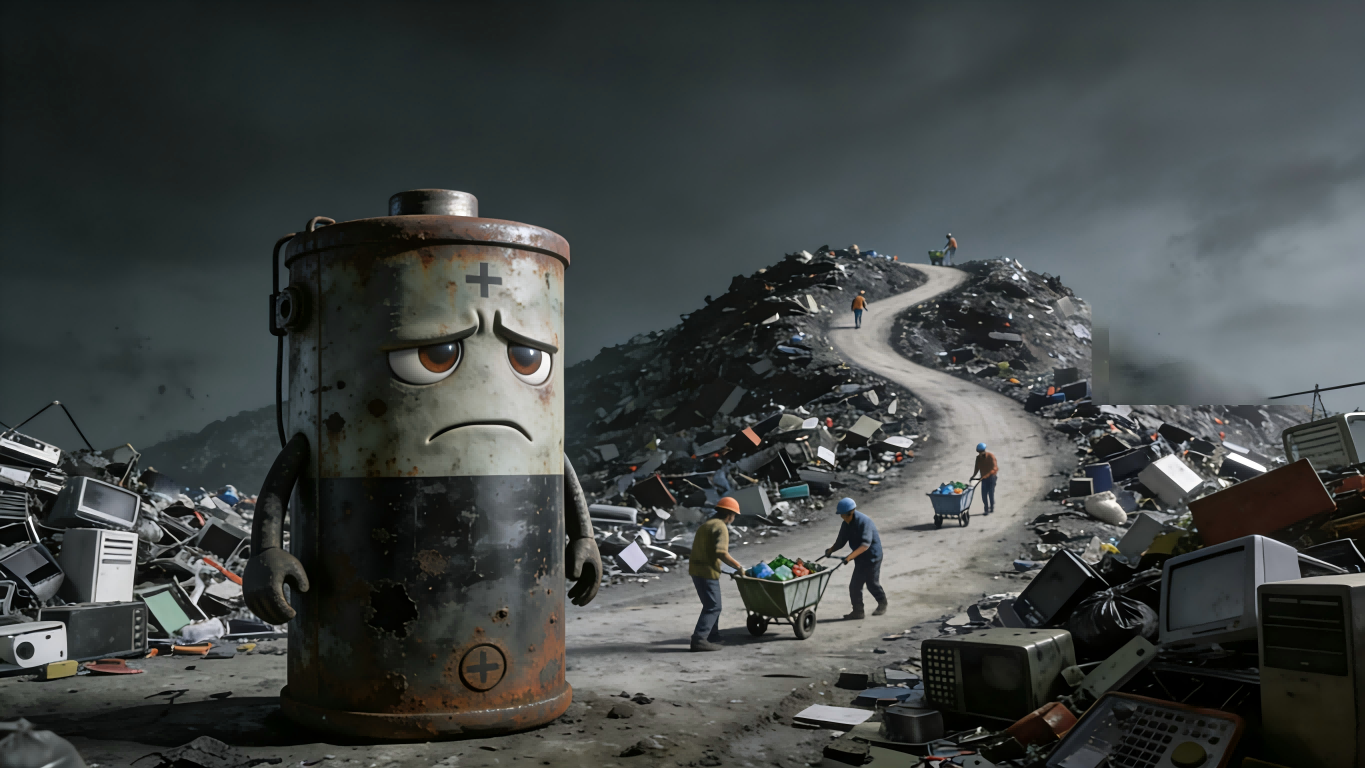
As the first wave of widely deployed power batteries begins to enter their "end-of-life phase," a market worth hundreds of billions is gradually unfolding before us. But is this market truly a sustainable industry driven by green environmental principles, or merely a "pseudo-business" surviving on policy subsidies? Let's cut through the hype and delve into a thorough analysis.
Part 1: The Cold Reality – The True State of the Current Recycling Industry
Speaking in Data: The Harsh Truth About Profitability
According to 2023 industry reports:
-
Formal Recyclers: 70% are operating at a loss or with minimal profits.
-
Raw Material Recovery Rates: The actual recovery rate for lithium is less than 50%, while cobalt and nickel can exceed 95%.
-
Cost Structure: Environmental compliance costs alone account for 30-40% of operational expenses.
"Formal Army" vs. "Guerrilla Forces": An Unlevel Playing Field
In battery collection hubs like Hunan and Guangdong, a stark dichotomy exists:
-
Formal Enterprises: Invest billions in automated production lines, strictly adhering to environmental standards.
-
Small Workshops: Utilize rudimentary physical disassembly and acid leaching extraction, with near-zero environmental costs.
Result: Small workshops often offer prices 15-20% higher than formal recyclers, leading to a significant flow of retired batteries into grey channels.
Part 2: Business Model Dissection – Where Does the Money Actually Come From?
Model 1: Raw Material Value Recovery (The Traditional Path)
-
Profit Logic: Extract and sell valuable metals (Cobalt, Nickel, Lithium, Copper, Aluminum) from spent batteries.
-
Real-World Challenge: Extreme lithium price volatility (e.g., Lithium Carbonate plummeting from 600,000 RMB/ton to 100,000 RMB/ton in 2023), causing inventory devaluation for recyclers.
-
Key Data Point: When Lithium Carbonate prices fall below ~150,000 RMB/ton, profitability based solely on material recovery becomes challenging.
Model 2: Cascaded Use (The Ideal Circular Economy)
-
Applications: Low-speed EVs, backup power, base station energy storage.
-
Technical Bottleneck: Poor consistency among retired cells makes it difficult to guarantee the lifespan of reassembled systems.
-
Economics: Testing, sorting, and reassembly costs can reach ~40% of new battery cost, while performance is only 60-70% of new batteries.
-
Case Study: A cascaded use project for telecom base stations saw actual operational costs exceed projections by 30%.
Model 3: Service Model under Extended Producer Responsibility (EPR)
-
Policy Requirement: Battery producers are responsible for recycling.
-
Business Model: Front-load recycling costs into the initial battery sale price.
-
Practical Difficulty: High logistics costs associated with efficiently collecting dispersed retired batteries nationwide and bringing them to processing centers.
Part 3: In-Depth Analysis of Policy Drivers
International Comparison: How Policy Shapes Markets
|
Country/Region |
Core Policy |
Market Effect |
|---|---|---|
|
European Union |
Battery Passport, Mandatory Recycling Rates, Carbon Footprint Restrictions |
Promotes closed-loop recycling, but increases corporate costs by over 30%. |
|
United States |
Inflation Reduction Act Tax Credits |
Attracts investment, but domestic recycling capacity remains insufficient. |
|
China |
Management Measures for the Recycling and Utilization of NEV Power Batteries |
Establishes a traceability platform, but enforcement varies regionally. |
China's Policy Toolkit
-
Subsidies: In 2023, MIIT provided subsidies to compliant recyclers based on processing volume.
-
Access System: Only 88 enterprises are currently on the "White List."
-
Traceability Management: Requires full life-cycle battery tracking.
Key Question: Can the business model survive independently after policy subsidies phase out?
Part 4: Technological Breakthroughs – The Only Path to Cost Reduction & Efficiency
Evolution of Crushing and Sorting Technology
-
1st Gen: Manual disassembly, poor safety.
-
2nd Gen: Mechanical crushing + hydrometallurgy, significant environmental pressure.
-
3rd Gen: Intelligent disassembly + physical sorting, recovery rates exceeding 95%.
-
Latest Direction: Direct Recycling technology, preserving cathode material structure and reducing remanufacturing costs by up to 40%.
Revolution in Testing and Assessment Technologies
-
Traditional Method: Charge/discharge testing, taking 12+ hours.
-
Innovative Technologies:
-
Electrochemical Impedance Spectroscopy (EIS): Assesses battery health state in under 5 minutes.
-
AI Prediction Models: Predict remaining useful life based on big data.
-
Non-Destructive Testing: Internal scanning using X-ray, ultrasound.
-
Breakthroughs in Material Regeneration Technology
-
LFP Recycling: From "Not Cost-Effective" to "New Opportunity"
-
Traditional Hydrometallurgy: Cost higher than material value.
-
New Generation Repair Technology: Direct regeneration of spent LFP cathode materials, reducing costs by ~60%.
-
-
Efficient Precious Metal Extraction: Novel extractants increase Co/Ni recovery rates from 95% to 99%.
Part 5: Predictions for the Economic Tipping Point
Factor Analysis Matrix
|
Influencing Factor |
Weight |
Trend Prediction |
|---|---|---|
|
Metal Price Volatility |
30% |
Long-term decline but with sharp fluctuations. |
|
Technological Progress |
25% |
Costs decreasing 8-10% annually. |
|
Policy Support |
20% |
Subsidies phasing out, but standards tightening. |
|
Economies of Scale |
15% |
30% cost reduction at 100,000 tons/year capacity. |
|
Environmental Costs |
10% |
Carbon trading may provide new revenue. |
Breakeven Point Predictions
-
Current: Lithium Carbonate price needs to remain at 180,000-200,000 RMB/ton.
-
2025 (Tech Progress + Scale): Breakeven drops to 120,000-150,000 RMB/ton.
-
2030 (Mature Tech + Established System): Profitability possible at 80,000-100,000 RMB/ton.
New Value Discovery
-
Carbon Asset Value: Recycling 1 ton of NMC batteries can reduce ~8 tons of CO₂ emissions, potentially integrated into carbon trading.
-
Data Value: Data from retired batteries can inform the design of next-generation batteries.
-
Supply Chain Security Value: Reduces reliance on imported minerals.
Part 6: Industry Chain Restructuring and Emerging Opportunities
Upstream Extension: Mining Companies' Moves
-
Companies like Tianqi Lithium, Huayou Cobalt are expanding into downstream recycling.
-
Logic: Smooth metal price volatility, secure raw material supply.
Midstream Specialization: Rise of Third-Party Services
-
Professional testing agencies: Offer fast, accurate battery residual value assessment.
-
Smart logistics platforms: Optimize collection networks, reduce transport costs.
-
Data service platforms: Full life-cycle battery data management.
Downstream Innovation: Developing New Applications
-
New Energy Storage Approach: Develop "low-cost, shorter-life" storage-specific cascaded batteries, not prioritizing longevity.
-
Material Downcycling: Use automotive-grade battery materials downgraded for e-bikes, power tools.
-
Creative Product Development: Repurpose battery modules into portable power stations, home backup power.
Part 7: Our Practice and Thinking
After years in this industry, we believe battery recycling must answer three fundamental questions:
-
How to resolve the conflict between environmental protection and economics?
Our choice: Technology-driven cost reduction.
-
Develop low-energy consumption crushing/sorting equipment (40% less energy).
-
Use environmentally friendly extractants (60% lower wastewater treatment cost).
-
Establish regional processing centers to reduce logistics carbon emissions.
-
-
How to build a sustainable business model?
Our exploration: Service-oriented transformation.
-
Offer "battery asset management," not just recycling services.
-
Collaborate with automakers, embedding recycling design from production.
-
Develop battery residual value insurance products to ease user concerns.
-
-
How to overcome policy dependence?
Our strategy: Create endogenous value.
-
Use recycled materials in own battery production, creating a closed loop.
-
Develop differentiated recycled materials with performance advantages over virgin materials.
-
Continuously lower the breakeven point through scale and technological breakthroughs.
-
Part 8: Advice for Different Stakeholders
Battery Producers
-
Act now: Establish recycling systems before mandates arrive.
-
Design for Recycling: Consider ease of disassembly/recycling from the cell design stage.
-
Data Assets: Accumulate battery usage data to support recycling assessment.
Recycling Enterprises
-
Prioritize Technology: Invest in advanced automated, intelligent recycling lines.
-
Scale Wins: Cost advantage is difficult without ~100,000 tons/year capacity.
-
Diversify: Material recovery + Cascaded use + Derivative services.
Investors
-
Long-term View: This is not a quick-in, quick-out industry.
-
Technical Barriers: Focus on companies with core recycling technology.
-
Full Industry Chain: Invest across testing, logistics, processing, remanufacturing.
Policy Makers
-
Standards First: Standardize battery specifications for automated disassembly.
-
Fair Regulation: Strictly crack down on non-compliant workshops.
-
Innovation Incentives: Support R&D in cutting-edge technologies like Direct Recycling.
Part 9: Key Trends for the Next Five Years
-
2024-2025: Policy tightening period, non-compliant players gradually phased out.
-
2026-2027: Key period for technological breakthroughs; new tech like Direct Recycling begins commercialization.
-
2028-2029: Scale effects become apparent; leading companies establish dominance.
-
2030 and beyond: Circular economy maturation; battery recycling becomes a stably profitable industry.
Conclusion: Not an Either/Or, but a Virtuous Cycle
Battery recycling is neither purely an eco-business nor solely a policy-driven industry. Rather, it is:
An emerging industry that starts within a policy framework, must achieve economic independence through technological innovation, and ultimately moves towards a win-win for both environment and commerce.
-
Short Term (1-3 years): Policy-driven dominance; companies need subsidies to survive.
-
Medium Term (3-5 years): Technology becomes key; costs determine survival.
-
Long Term (5+ years): Market drivers ultimately take hold; environmental and economic benefits align.
The true tipping point will arrive when technological breakthroughs make recycling costs lower than mining costs. According to our estimates, this moment will arrive around 2028.
At that point, battery recycling will no longer be a question of "is it worth doing?" but will become a "must-have" core competency. Companies that start deepening their technology, building their networks, and exploring models now will gain a decisive advantage in the future circular economy era.
Battery Degradation Anxiety? Understand These 3 Metrics to Easily Gauge Battery Health
The Last Line of Defense in Battery Safety Design: A Deep Dive into Fire Barrier Strategies for Battery Packs
Related Article